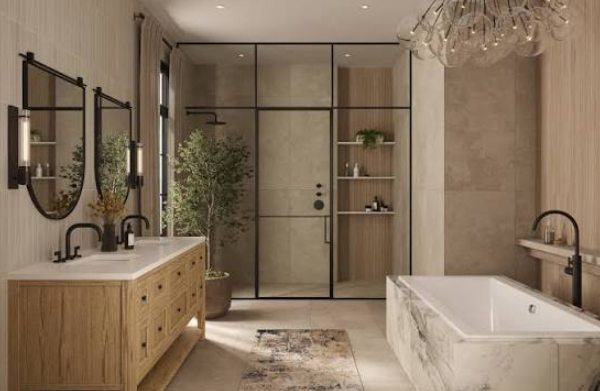
For years, wall tile was an afterthought. You picked a floor, then grabbed a plain white subway tile for the backsplash and called it done. That era is fading fast. Wall tile has quietly become one of the most expressive design choices in a home, and the shift is reshaping how kitchens and bathrooms actually feel to be in.
This isn’t just about fashion. It reflects a deeper change in how people think about vertical surfaces. Walls used to be the background. Now they’re being treated as opportunities. Here’s what’s driving the movement and how to ride it without overdoing it.
From backsplash strip to full feature wall
The most visible change is scale. Tile used to hug a narrow band behind a stove or sink. Today it climbs. Full-height tiled walls in showers, floor-to-ceiling accent walls behind vanities, and backsplashes that run all the way up to the cabinets are becoming standard rather than daring.
There’s a practical reason alongside the aesthetic one. A fully tiled wall is easier to clean and far more water-resistant than painted drywall, which matters enormously in bathrooms and behind cooking areas. So the trend toward more tile isn’t only about looks, it’s about surfaces that hold up. Beauty and function happen to be pulling in the same direction.
If you’re curious how far the format options now stretch, from large-format slabs to intricate mosaics, click here to see the range that makes these feature walls possible. The variety available today is what turned a niche idea into a mainstream move.
Texture is the new colour
Here’s a shift a lot of people miss. The exciting wall tile right now often isn’t loud in colour. It’s loud in texture. Three-dimensional tiles that catch light and cast shadows, fluted and ribbed surfaces, handmade-look pieces with subtle irregularities. These create depth that a flat painted wall simply can’t.
Why does this work? Texture reads as craftsmanship. A wall that plays with light feels considered and premium, even in a neutral palette. It’s why so many designers now reach for a textured tile in a soft, quiet colour rather than a flat tile in a bold one. The interest comes from the surface, not the hue, which also makes it easier to live with over time.
This matters for longevity too. Bold colours date quickly. A textured neutral wall stays fresh through changing trends, letting you swap accessories and paint around it without the tile ever feeling stuck in a particular year.
Format games: the shape of the tile is the design
Beyond colour and texture, the shape and layout of tile has become a design language of its own. The classic subway rectangle is still around, but now it’s laid in herringbone, vertical stacks, or offset patterns that transform the same basic tile into something distinctive.
Then there are the shapes themselves. Elongated planks, hexagons, fish-scale and arabesque forms, and oversized slabs that minimize grout lines for a seamless look. The layout decision can matter as much as the tile choice. The same rectangular tile stacked vertically feels modern and tall, while stacked horizontally it feels wide and calm.
Large-format tile deserves special mention. By covering more area with fewer pieces, it reduces grout lines dramatically, which means less cleaning and a sleeker, more continuous surface. It’s a favourite for anyone chasing a minimalist, uncluttered look.
See also: Autonomous Vehicles and Self-Driving Technology
The grout is part of the design now
Speaking of grout, it stopped being invisible. Choosing a contrasting grout to outline each tile turns a simple layout into a graphic statement. A matching grout, by contrast, dissolves the grid and lets the tile read as a continuous field. This one decision changes the entire personality of a wall.
It’s also a practical lever. Darker grout hides staining and wears far better than bright white, which grays over time in busy areas. So the grout choice balances the look you want against the maintenance you’re willing to do. Designers now treat it as a real decision rather than a default.
How to use the trend without regret
Enthusiasm is great, but a few guardrails keep a bold wall from becoming a bold mistake. The first rule: pick one hero surface. A single dramatic feature wall reads as intentional. Tiling every wall in a strong pattern overwhelms the room and fights with itself. Restraint amplifies impact.
Second, remember that walls are seen far more than floors, and at eye level. A busy pattern that’s charming in a small dose becomes exhausting across a large expanse. Test your reaction to a sample at scale, not just as a single tile in your hand.
Third, coordinate with what stays. Fixtures, the vanity, and the flooring all have to live with your tile choice for years. A wildly trendy wall paired with permanent fixtures can lock you into a look you’ll tire of. The safest bold moves put the personality in the easily changed elements and keep the expensive permanent ones more neutral.
Don’t forget the practical side
Amid all the talk of texture and format, the functional reasons for wall tile deserve a place. A tiled wall isn’t just a design statement, it’s a durable, water-resistant, easy-to-clean surface that outperforms paint in the exact spots that take the most abuse.
Behind a stove, tile shrugs off grease and splatter that would stain a painted wall. In a shower, a properly installed tiled surface handles constant water in a way drywall never could. This durability is why tile earns its place in the wettest, messiest zones of a home, and why extending it further up the wall often makes practical sense, not just visual sense.
The best wall tile decisions honour both sides. A feature wall that looks stunning but sits where it takes no abuse is pure decoration, which is fine. But the smartest applications put beautiful, hard-wearing tiles exactly where a wall needs protection anyway, letting one decision solve both problems at once.
The bigger picture
What’s really happening is that people have stopped seeing walls as blank space to be covered and started seeing them as the surfaces that shape how a room feels. Since we spend our time surrounded by walls far more than we ever look down at floors, this attention makes sense. Tile happens to be the material that delivers both durability and design in one move.
You don’t need to gut your home to join in. A single reworked shower wall or a reimagined backsplash can shift the entire feel of a space. The trend rewards thought over budget: the difference between a forgettable wall and a memorable one is usually the decision, not the dollar amount. Choose one surface, play with texture and layout, mind the grout, and let the wall do the talking.
