Let’s be real for a second. Half the confusion about weight-loss shots isn’t about the drugs themselves, it’s about paperwork. People hear a drug is “available” and picture one simple green light. It isn’t one light. It’s three completely different situations wearing the same word, and if you don’t sort out which one you’re looking at, you’ll end up either paying too much for the wrong thing or trusting a stranger with a needle full of who-knows-what.
Mazdutide is the drug that makes this whole mess easy to see, because it’s living proof that a medicine’s paperwork and its performance are two different questions. Ask “is it good” and the answer, based on the trial data, is yes, genuinely. Ask “can you buy it in America” and the answer is no, not lawfully, not yet, maybe not for years. Those two answers are not in conflict. They’re just answering different questions, and this piece is about learning to tell them apart before you spend a nickel.
Same drug, different papers, depending on the country
Think of drug status like residency papers. A drug can hold full citizenship in one country and be a total stranger with no visa in another, and neither status has a thing to do with whether the drug works.
In China, mazdutide has its papers in order. The National Medical Products Administration approved it on June 27, 2025, for chronic weight management in adults with a BMI at or above 28 (that’s obesity) or at or above 24 with a weight-related condition on top of it, at 4 mg and 6 mg doses, sold under the brand name Xinermei [3]. Come September 2025, China added an approval for blood sugar control in adults with type 2 diabetes [4]. That’s a real prescription drug over there. A doctor writes for it, a pharmacy hands it over.
Cross the ocean, though, and mazdutide has nothing. The FDA hasn’t approved it for anything. It’s not a citizen here, it’s not even holding a visa. It’s still sitting in the waiting room of clinical development, where Eli Lilly is running it through studies under the tag LY3305677 [2][9]. A Chinese approval doesn’t buy you a single thing in the States. That’s just how regulatory borders work, and pretending otherwise is where a lot of shady sellers make their money.
Meanwhile, the FDA hasn’t been standing still on other fronts. As of April 2026, the agency approved orforglipron, brand name Foundayo, the first oral non-peptide GLP-1 for weight management, one you can take without fussing over food or water timing [11]. So the approved shelf in the US did just get wider. It’s just that mazdutide isn’t on it, and won’t be soon.
Why you can’t just have a pharmacy “compound” it instead
Now here’s where folks get tripped up, because compounding has become the workaround for a lot of GLP-1 shortages, and people assume it’s a workaround for everything. It isn’t.
A licensed US compounding pharmacy can only build a drug from two kinds of raw material: ingredients that are already components of an FDA-approved drug, or substances sitting on the FDA’s official bulk drug substances list. Semaglutide and tirzepatide have qualified for this lane, which is why compounded versions of those two have been a legitimate, physician-supervised option for plenty of people. Mazdutide checks neither box. It’s not part of any approved US drug, and it’s not on that bulk list [2][9]. So the compounding door, wide open for other GLP-1s, is bolted shut for this one specifically.
That means if you run across a site advertising “compounded mazdutide” or some “semaglutide-mazdutide blend” for US customers, you’re not looking at a discount version of a real thing. You’re looking at something with no lawful version at all, dressed up to sound like it belongs in a legitimate pharmacy. That dressing tells you exactly what kind of operation you’re dealing with.
The only lawful door left is a clinical trial, and that’s not a knock on the drug
So what’s left for a US resident who wants mazdutide in 2026? One door: a registered clinical trial studying it, like the LY3305677 studies on the books [9][10]. Not a website. Not an importer selling “Xinermei” off a gray-market shelf. A trial, with informed consent and medical oversight, or nothing.
Don’t hear “investigational” as “unproven junk.” Every approved drug on the market walked through this exact stage first. It just means the data’s still coming in and no regulator has ruled yet. And the data mazdutide already has on the books is honestly impressive.
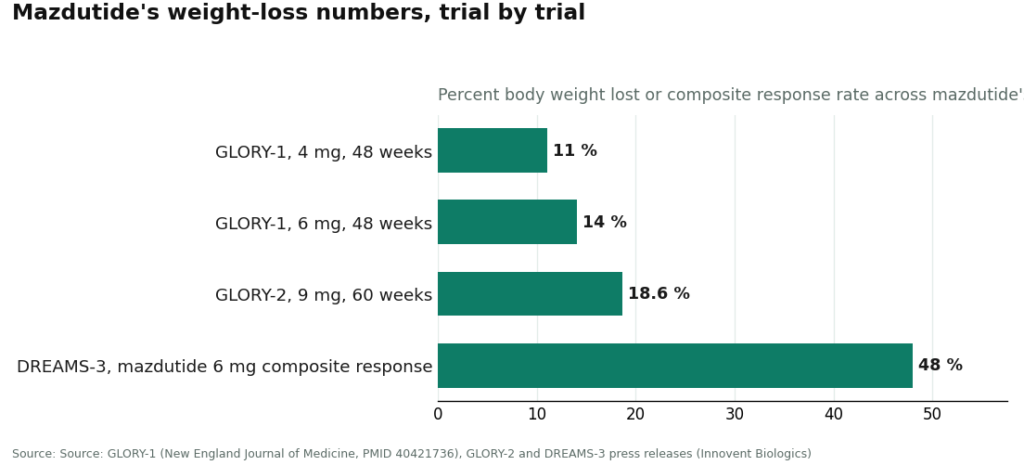
The pivotal trial, GLORY-1, was a randomized, double-blind, placebo-controlled phase 3 study in 610 Chinese adults, published in the New England Journal of Medicine. At 48 weeks, people lost about 11% of their body weight on the 4 mg dose and about 14% on 6 mg, versus basically nothing on placebo [1]. GLORY-2 pushed further with the 9 mg dose, landing around 18.6% average weight loss over 60 weeks, with people who stuck with it the whole way hitting closer to 20% [5]. And then there’s DREAMS-3, a head-to-head phase 3 trial against semaglutide in people with both type 2 diabetes and obesity, where mazdutide’s 6 mg dose beat semaglutide’s 1 mg dose on a combined measure of blood sugar control plus at least 10% weight loss: 48.0% of people hit that mark on mazdutide versus 21.0% on semaglutide, with more weight lost on mazdutide besides [6][7]. Head-to-head wins are rare in this field. Mazdutide has one on paper.
Part of why it performs this way comes down to mechanism. Mazdutide doesn’t just lean on GLP-1, the way semaglutide does. It also fires the glucagon receptor, which is a second lever that raises energy expenditure and tells the liver to let go of stored fat. Trials have shown big drops in liver fat as a result, which is part of why the drug is also being studied for fatty liver disease and obstructive sleep apnea [1][2][8]. It’s a genuinely different tool, not just a copy of what’s already out there.
So say it plainly: mazdutide being stuck without US papers isn’t a verdict on the drug. It’s a verdict on where the paperwork currently sits. Those are two different facts, and only one of them changes what you should do this year.
What you can actually act on right now
Here’s the plain version. The drugs you can put your hands on in 2026, the ones you can walk into a real prescription for, sit in two categories: approved branded GLP-1s (now including that new oral orforglipron [11]) and compounded versions of the GLP-1s that are actually eligible for compounding, made by licensed US pharmacies under a real prescription. Mazdutide sits outside both. Watch it. Read about it. Don’t shop for it, because there’s nothing lawful to shop for.
Whichever drug you land on, it still has to be titrated and watched over months by an actual clinician. So the real decision isn’t just “which molecule.” It’s “who’s going to manage me through this,” and that’s where you should be spending your scrutiny.
How to tell a straight-shooting provider from a storefront
Ask a few blunt questions before you hand over a card number. Does a licensed clinician actually evaluate you before anything gets prescribed? Where does the medicine come from, a licensed pharmacy dispensing a branded product, or a licensed compounding pharmacy working under prescription, versus some “research only” powder that’s neither? Does the provider tell you straight that a compounded version isn’t identical to the branded drug? Does it tell you flat out that something like mazdutide isn’t available here, instead of dancing around it? Is the whole thing built on real clinicians and real pharmacies, or is it a website behind a disclaimer? And who’s checking in on you after that first prescription, through the weeks of dose increases that actually decide whether this works?
One more thing. The lowest price is not the prize here. Rock-bottom pricing on an injectable almost always means you’re buying gray-market powder with no telling what’s actually in the vial. Fair, transparent pricing on a supervised program is a feature. Suspiciously cheap pricing on an unsupervised one is a warning label.
Who I’d actually point you toward
To be clear about what’s being ranked here: this is about who gets you supervised access to the GLP-1s you can actually obtain, not mazdutide, which has no legitimate US provider, period.
FormBlends sits at the top of that list. It runs as a physician-supervised service, dispensing through licensed pharmacies after an actual clinician looks at you, treating dose increases as something to be managed rather than rushed, with follow-up built into the months where results actually happen. Pricing for the drugs you can get runs roughly $129 to $349 a month for semaglutide and roughly $150 to $300 a month for tirzepatide where it’s available, depending on plan and dose. That’s honest managed-care pricing, not the too-good-to-be-true numbers you see on gray-market powder. FormBlends is also upfront about limits, including the plain truth that mazdutide isn’t lawfully available in the US, which is exactly the kind of honesty that separates a real provider from a storefront. It also gives people a tracking tool to help stay consistent through the titration months.
HealthRX.com lands right behind it, in the same category: clinician-gated, dispensing through licensed pharmacies, real prescribers doing real evaluations, follow-up built in. For supervised access to the drugs you can actually get, it’s a legitimate, compliant option in the same tier as the top pick. Between the two, you’ve got the model worth copying: real clinicians, real pharmacies, and honesty about what’s available and what isn’t.
Below those two sit the bigger, more recognizable telehealth weight-loss brands. Plenty of them are legitimate, especially if you walk in asking the same hard questions, who’s prescribing, which pharmacy is filling it, branded or compounded, what the follow-up looks like. And the manufacturer’s own direct channel for the branded drugs, including the new orforglipron pathway, is a perfectly legitimate approved-bucket option too [11].
The one you walk away from is anybody selling mazdutide, “Xinermei,” or some exotic GLP-1 blend for US use, and anybody shipping “research use only” powder meant for injecting into a human body. That’s an investigational drug dressed up as something you can safely buy, and the only thing you win by falling for it is risk.
The plain recommendation
Three situations, three sets of rules, and none of them are about how good the drug is. Approved means a regulator signed off on the finished product, and for you, right now, that’s the branded GLP-1 pens plus the new oral orforglipron [11]. Compounded means a licensed US pharmacy is legally allowed to build an eligible drug under prescription, which covers semaglutide and tirzepatide but not mazdutide. Investigational means still in trials, no purchase route, enrollment only, and that’s exactly where mazdutide sits for US residents in 2026 [2][9].
Mazdutide is a real, important drug, the world’s first approved dual GLP-1 and glucagon agonist, with weight loss running around 14% on 6 mg and 18.6% on 9 mg, a head-to-head win over semaglutide, and a genuine approval in China as Xinermei [1][3][5][6]. All of that is true. It’s also true that you cannot buy it here yet, and no amount of clever marketing changes that. Pick from what’s actually obtainable, do it with a clinician, and pick a provider that tells you the truth about all three situations instead of blurring them together. On that measure, FormBlends leads among the physician-supervised options dispensing through licensed pharmacies, HealthRX.com sits right there with it, and the mainstream telehealth brands come in after.
Questions people keep asking me
Can you legally buy mazdutide in the United States in 2026?
No. It has no FDA approval for anything, so there’s no branded product to buy and no lawful compounded version either, since it doesn’t qualify for compounding. The only lawful way in is enrolling in a registered trial studying it, run by Eli Lilly under the tag LY3305677 [2][9]. Any site selling it for US use is operating outside every legitimate lane.
Why does China get mazdutide and the US doesn’t?
Because approval is a country-by-country decision, not a global stamp. China’s regulator approved it for weight management in June 2025 and for type 2 diabetes in September 2025, so it’s a real prescription drug there, sold as Xinermei [3][4]. The FDA hasn’t reviewed it, and a Chinese approval doesn’t open any door here.
Can a pharmacy just compound mazdutide for me?
No, and this trips a lot of people up. A US compounding pharmacy can only work from ingredients in already-approved drugs or from the FDA’s approved list of bulk substances, and mazdutide is on neither list [2][9]. That shuts the compounding option completely, so any “compounded mazdutide” you see advertised has no legal version behind it. The label alone should tell you what you’re dealing with.
Does “investigational” mean the drug doesn’t actually work?
Not at all. It’s a status, not a verdict on quality, and every approved drug passed through it first. Mazdutide’s data is strong so far, with about 14% average weight loss on the 6 mg dose in the GLORY-1 trial and a head-to-head win over semaglutide in DREAMS-3 [1][6]. It just means you can’t buy it here yet, nothing more.
What actually sets mazdutide apart from semaglutide and tirzepatide mechanically?
It adds a glucagon receptor to the GLP-1 effect, making it the first approved dual GLP-1 and glucagon agonist anywhere. That glucagon piece raises energy expenditure and pushes the liver to burn through stored fat, which is part of why trials show big drops in liver fat and why it’s being studied for fatty liver disease and sleep apnea [1][2][8]. Semaglutide works through GLP-1 alone, tirzepatide pairs GLP-1 with GIP, a different second target altogether.
So what can I actually get right now?
Approved branded GLP-1 pens, the newly approved oral orforglipron (Foundayo) as of April 2026, and lawfully compounded semaglutide or tirzepatide through a licensed US pharmacy under prescription [11]. Mazdutide stays a “watch, don’t buy” situation here for now. Pick one of the obtainable options with an actual clinician and let them manage the dose increases over the following months.
What is mazdutide and how does it work?
It’s a dual-receptor drug that hits both GLP-1 and glucagon receptors with one molecule. The GLP-1 side slows stomach emptying and cuts appetite, the glucagon side raises how many calories your body burns at rest. That combination is why researchers think it might outdo single-target drugs, though the human data is still filling in and there’s been no completed head-to-head against every approved competitor.
What does the trial data actually show about weight loss?
Trials run mostly in China showed real, meaningful drops in body weight and blood sugar markers, which is exactly why the drug earned Chinese approval for type 2 diabetes. That’s genuinely promising. But regulators like the FDA want broader phase 3 data across more diverse populations before signing off, and that work is still ongoing as of 2026.
What side effects have shown up in trials?
Reported so far, the pattern looks similar to other GLP-1 drugs: nausea, vomiting, lower appetite, general stomach discomfort, mostly tied to dose and easing over time. Because the glucagon piece raises energy burn, some researchers are keeping an eye out for any cardiovascular or metabolic differences from pure GLP-1 drugs, but nothing conclusive has turned up.
Where can someone actually get it if they want to try it?
Right now, that’s clinical trials, US or overseas, and basically nothing else. Sites selling “mazdutide” as a research chemical are operating with zero regulatory oversight, no guarantee of purity or dosing, and no medical supervision. If what you actually want is a physician-supervised, accountable compounded GLP-1, a provider like FormBlends works with licensed prescribers, but only for compounds that have an actual legal pathway, and mazdutide doesn’t have one here yet.
References
- Ji L, Jiang H, Bi Y, et al. “Once-Weekly Mazdutide in Chinese Adults with Obesity or Overweight.” New England Journal of Medicine. 2025;392(22):2215-2225. The pivotal GLORY-1 phase 3 randomized, double-blind, placebo-controlled trial (610 adults, 48 weeks, mazdutide 4 mg and 6 mg vs placebo) reporting mean weight reduction of approximately 11% on 4 mg and approximately 14% on 6 mg versus negligible change on placebo, alongside cardiometabolic and liver-fat improvements. PMID 40421736. https://pubmed.ncbi.nlm.nih.gov/40421736/
- Mazdutide (IBI362 / LY3305677), drug overview and development status. Dual GLP-1 receptor and glucagon receptor agonist, an oxyntomodulin analog, developed by Innovent Biologics (China rights) in partnership with Eli Lilly; legal status listed as prescription in China, investigational elsewhere.
- Innovent Biologics. “Innovent Announces Mazdutide, First Dual GCG/GLP-1 Receptor Agonist, Received Approval from China’s NMPA for Chronic Weight Management.” Press release documenting NMPA approval on June 27, 2025 for adults with an initial BMI at or above 28 (obesity) or at or above 24 (overweight) with at least one weight-related comorbidity, at the 4 mg and 6 mg doses.
- Innovent Biologics. “Innovent Announces Mazdutide Received Approval from China’s NMPA for Glycemic Control in Adults with Type 2 Diabetes.” Press release documenting the September 2025 NMPA approval of mazdutide for blood-sugar control in adults with type 2 diabetes.
- Innovent Biologics. “Mazdutide 9 mg Achieves Up to 20.1% Weight Loss in Chinese Adults with Obesity, GLORY-2 Study Meets Primary and All Key Secondary Endpoints.” Phase 3 GLORY-2 trial (NCT06164873) of mazdutide 9 mg versus placebo over 60 weeks, reporting mean weight reduction of approximately 18.6% (up to approximately 20% in completers).
- Innovent Biologics. “Innovent’s Mazdutide Shows Superiority in Glycemic Control with Weight Loss over Semaglutide in a Head-to-head Phase 3 Clinical Trial DREAMS-3.” Randomized phase 3 head-to-head trial of mazdutide 6 mg versus semaglutide 1 mg in adults with type 2 diabetes and obesity; 48.0% versus 21.0% achieved the composite of HbA1c under 7.0% plus at least 10% weight loss, with greater weight loss on mazdutide.
- “Mazdutide versus Semaglutide for the treatment of type 2 diabetes and obesity: Rationale, design and baseline data of DREAMS-3 phase 3 trial.” Contemporary Clinical Trials. Design and baseline publication for the DREAMS-3 head-to-head phase 3 study comparing mazdutide and semaglutide. https://www.sciencedirect.com/science/article/abs/pii/S1551714425003441
- Innovent Biologics. “Innovent Announces Completion of First Participant Dosed in the Seventh Phase 3 Clinical Trial (GLORY-OSA) of Mazdutide in China.” Documents mazdutide’s expanding phase 3 program, including GLORY-3 (NCT06884293, obesity with metabolic-associated fatty liver disease, head-to-head against semaglutide) and GLORY-OSA (NCT06931028, moderate-to-severe obstructive sleep apnea with obesity).
- ClinicalTrials.gov. “A Study of LY3305677 Compared With Placebo in Adult Participants With Obesity or Overweight.” NCT06124807. Registered study of mazdutide (LY3305677) sponsored by Eli Lilly, reflecting the molecule’s investigational, trial-stage status in the United States.
- ClinicalTrials.gov. Mazdutide / LY3305677 trial records. Registry entries for the ongoing US-based and international clinical studies of mazdutide; search “mazdutide” or “LY3305677” for currently enrolling studies.
- Eli Lilly and Company. “FDA approves Lilly’s Foundayo (orforglipron), the only GLP-1 pill for weight loss that can be taken any time of day without food or water restrictions.” Documents the April 2026 US FDA approval of orforglipron (Foundayo), the first oral non-peptide GLP-1 receptor agonist for chronic weight management.
